

ढाँचा:Infobox planet/doc
 | This is a documentation subpage for ढाँचा:Infobox planet. It contains usage information, categories and other content that is not part of the original ढाँचा page. |
 | This template is used on ४,५००+ pages and changes may be widely noticed. Test changes in the template's /sandbox or /testcases subpages, or in your own user subpage. Consider discussing changes on the talk page before implementing them. |
| This ढाँचा employs intricate features of template syntax.
You are encouraged to familiarise yourself with its setup and parser functions before editing the template. If your edit causes unexpected problems, please undo it quickly, as this template may appear on a large number of pages. You can conduct experiments, and should test all major changes, in either this template's sandbox, the general template sandbox, or your user space before changing anything here. |
This template has been designed for the presentation of information on non-stellar astronomical bodies: planets (including extrasolar planets), dwarf planets, moons and minor planets. Some parameters will not be applicable to individual types; these may be omitted without any problems to the template's function.
Usage notes
[स्रोत सम्पादन]- This template expects that the
<references />tag will be present in articles ढाँचा:Clarify span. Pages without a<references />tag will show Cite error: There are<ref>tags on this page for a group named "note", but the references will not show without a<ref group="note">tag; see Help:Cite errors. at the bottom of the page. - When parameters relating to minor planets are used (e.g. mpc_name), several subheadings and wikilinks within the template are made specific to minor planets. For standard formulas for computable values and sources of physical data, see Template talk:Infobox Nonstellar body#Computed values and Standard asteroid physical characteristics.
- The proper orbital element "Proper orbital period" (in Julian years and days) is calculated within the template from proper mean motion and so does not require a parameter.
- For bodies orbiting bodies other than the Sun, include the parameter
|apsis= (appropriate suffix). This will replace various parameters' default "-helion" suffix to the suffix set by the|apsis=parameter. For example, setting|apsis= astronconverts the labels "perihelion", "aphelion" and "Argument of perihelion" into "periastron", "apastron" and "Argument of periastron" respectively.
Recommended parameters
[स्रोत सम्पादन]Planets and exoplanets
[स्रोत सम्पादन]See § All parameters for a complete listing.
| [[File:image|225x225px|alt=image_alt|image_alt]] caption | |
| Discovery | |
|---|---|
| Discovered by | discoverer |
| Discovery site | discovery_site |
| Discovery date | discovered |
| discovery_method | |
| Designations | |
| alt_names | |
| Orbital characteristics | |
| semimajor | |
| Eccentricity | eccentricity |
| period | |
Average orbital speed | avg_speed |
| Inclination | inclination |
| angular_dist | |
| long_periastron | |
| time_periastron | |
| Semi-amplitude | semi-amplitude |
| Physical characteristics | |
Mean radius | mean_radius |
| surface_area | |
| Volume | volume |
| Mass | mass |
Mean density | density |
| surface_grav | |
| moment_of_inertia_factor | |
| escape_velocity | |
| Albedo | albedo |
| Temperature | single_temperature |
{{Infobox planet
| extrasolarplanet   = yes
| name               = <!--on top of infobox-->
| image              =
| image_alt          =
| caption            =
| apsis              = astron
| discovery_ref      = <!-- <ref>...</ref>-->
| discoverer         =
| discovery_site     =
| discovered         = <!--(Date)-->
| discovery_method   =
| alt_names          = <!--(Any alternative names for the body)-->
| periastron         =
| apoastron          =
| semimajor          =
| avg_speed          = <!--(Average orbital speed)-->
| eccentricity       =
| period             = <!--(Orbital period)-->
| inclination        =
| angular_dist       =
| long_periastron    = <!--(Longitude of periastron)-->
| time_periastron    = <!--(Time of periastron)-->
| semi-amplitude     =
| mean_radius        = <!--(For planets & large, spheroidal minor planets)-->
| surface_area       =
| volume             =
| density            =
| mass               =
| surface_grav       = <!--Equatorial surface gravity-->
| moment_of_inertia_factor =
| escape_velocity    =
| albedo             =
| single_temperature =
}}
Minor planets
[स्रोत सम्पादन]See § All parameters for a complete listing.
| [[File:image|225x225px|alt=image_alt|image_alt]] caption | |||||||||||||
| Discovery[१] | |||||||||||||
|---|---|---|---|---|---|---|---|---|---|---|---|---|---|
| Discovered by | discoverer | ||||||||||||
| Discovery site | discovery site | ||||||||||||
| Discovery date | discovered | ||||||||||||
| Designations | |||||||||||||
| MPC designation | mpc_name | ||||||||||||
| alt_names | |||||||||||||
| mp_category | |||||||||||||
| Orbital characteristics[२] | |||||||||||||
| Epoch epoch | |||||||||||||
| Uncertainty parameter uncertainty | |||||||||||||
| Observation arc | observation arc length | ||||||||||||
| Aphelion | aphelion | ||||||||||||
| Perihelion | perihelion | ||||||||||||
| semimajor | |||||||||||||
| Eccentricity | eccentricity | ||||||||||||
| period | |||||||||||||
Average orbital speed | avg_speed | ||||||||||||
| mean_anomaly | |||||||||||||
| mean_motion | |||||||||||||
| Inclination | inclination | ||||||||||||
| asc_node | |||||||||||||
| arg_peri | |||||||||||||
| Known satellites | satellites | ||||||||||||
| Earth MOID | earth moid | ||||||||||||
| Mercury MOID | (see All parameters) | ||||||||||||
| Proper orbital elements[३] | |||||||||||||
Proper semi-major axis | p_semi_major AU | ||||||||||||
Proper eccentricity | p_eccentricity | ||||||||||||
Proper inclination | p_inclination | ||||||||||||
Proper mean motion | 360 deg / yr | ||||||||||||
Proper orbital period | 1 yr (365.25 d) | ||||||||||||
Precession of perihelion | perihelion_rate arcsec / yr | ||||||||||||
Precession of the ascending node | node_rate arcsec / yr | ||||||||||||
| Physical characteristics[४] | |||||||||||||
| Dimensions | dimensions | ||||||||||||
| Mass | mass | ||||||||||||
Mean density | density | ||||||||||||
Equatorial surface gravity | surface_grav | ||||||||||||
| moment_of_inertia_factor | |||||||||||||
Equatorial escape velocity | escape_velocity | ||||||||||||
Sidereal rotation period | sidereal_day | ||||||||||||
| axial_tilt | |||||||||||||
Pole ecliptic latitude | pole_ecliptic_lat | ||||||||||||
Pole ecliptic longitude | pole_ecliptic_lon | ||||||||||||
| albedo | |||||||||||||
| |||||||||||||
| spectral_type | |||||||||||||
| abs_magnitude | |||||||||||||
{{Infobox planet
| minorplanet        = yes
| background         = #FFFFC0 <!--default color, yellow-->
| name               =
| symbol             =
| image              =
| image_alt          =
| caption            =
| discovery_ref      = <ref>...</ref>
| discoverer         =
| discovered         =
| discovery_site     = ''discovery_site''
| mpc_name           = <!--(Minor Planet Center's designation)-->
| mp_category        = <!--(Minor planet category)-->
| alt_names          = <!--(Alternative names)-->
| orbit_ref          = <ref>...</ref>
| epoch              =
| uncertainty        = [[Uncertainty Parameter U]]
| observation_arc    = [[Observation arc]] length
| aphelion           =
| perihelion         =
| semimajor          =
| eccentricity       =
| period             =
| avg_speed          = <!--(Average orbital speed)-->
| inclination        =
| asc_node           = <!--(Longitude of ascending node)-->
| mean_anomaly       =
| mean_motion        = <!--(Instantaneous orbital mean motion)-->
| arg_peri           = <!--(Argument of perihelion)-->
| p_orbit_ref        = <ref>...</ref>
| p_semimajor        =
| p_eccentricity     =
| p_inclination      =
| p_mean_motion      = <!--(Proper orbital mean motion)-->
| perihelion_rate    = <!--(Proper perihelic precession rate)-->
| node_rate          = <!--(Proper nodal precession rate)-->
| satellites         =
| moid               = <!--(Earth moid only)-->
| mercury_moid       = <!--(see "All parameters" section)-->
| physical_ref       = <ref>...</ref>
| dimensions         = <!--(Uni/bi/tri-axial dimensions)-->
| mass               =
| density            =
| surface_grav       = <!--(Equatorial surface gravity)-->
| moment_of_inertia_factor = <!--(Moment of inertia factor)-->
| escape_velocity    =
| sidereal_day       =
| axial_tilt         =
| pole_ecliptic_lat  = <!--(Pole ecliptic latitude)-->
| pole_ecliptic_lon  = <!--(Pole ecliptic longitude)-->
| albedo             =
| spectral_type      =
| abs_magnitude      = <!--(Absolute magnitude)-->
| single_temperature =
}}
See here for means of semi-automating this template's transclusion as regards minor planets.
- For satellites of minor planets, include the parameter
|apsis= astron(see above).
Notes on usage
[स्रोत सम्पादन]Most of these entries should be measured in SI units. Some of them, however, should have more "human-accessible" units, in addition to SI units: several such cases are indicated with a second unit name in brackets. In the case of times (orbital periods, rotation), it is best to give all periods in days for comparison purposes, and provide a translation (in parentheses) into years, days, hours, etc.; whatever is most appropriate for the duration being described.
This template is very flexible. Moons with no atmosphere whatsoever could skip the atmospheric composition section entirely, for example (though atmospheric density would still be listed). Moons also wouldn't have their orbital radii listed in AU, since AUs are such large units. For planets, use "perihelion" and "aphelion" instead of "periapsis" and "apoapsis."
In the case of "number of moons" and "is a moon of", only one of these rows will be used by any given object. There aren't any moons with moons (yet), though perhaps "co-orbital with" might be a useful row to add in a few cases.
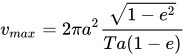
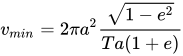
On orbital characteristics: The orbital circumference should be computed from the semi-major axis using Ramanujan's approximation for ellipses. The ratio of that circumference to the period then gives the average orbital speed. The minimum and maximum speeds follow from Kepler's laws: and . Note that, by convention, all orbital parameters are given in the primocentric reference system (heliocentric for the planets).
On proper orbital elements: The formulae used by the template to convert from proper mean motion to proper orbital motion are:
Oyears = 360 / M and
Odays = 365.25 x Oyears
On physical characteristics: The surface area and volume of non-spherical objects (e.g. moonlets, asteroids) must use the proper ellipsoid formulae, because even slight departures from sphericity will make a large difference, particularly for the area.
On the subject of obliquity: Obliquity is the angle between the object's axis of rotation and the normal to the plane of its orbit. Do not confuse this with the tilt listed in the JPL pages, which is a measure of the angle between the local Laplace plane and the primary's equatorial plane. In fact, most inner moons have synchronous rotations, so their obliquities will be, by definition, zero. Outer moons simply have not been seen from close up enough to determine their true obliquities (although Phoebe, recently seen by Cassini, is an exception; see Talk:Phoebe (moon) for the derivation of its obliquity).
All parameters
[स्रोत सम्पादन]{{Infobox planet
| minorplanet = yes <!-- enables features for minor planets -->
| extrasolarplanet = yes <!-- enables features for extrasolar planets -->
| width = <!-- Defunct. Do not use it. Remove it from existing templates. -->
| label_width = <!-- Sets the parameter name column's max width. Defaults to 11em. -->
| name = <!-- displayed in caption of infobox -->
| symbol = <!--[[File:...|14px]]-->
| image = <!--[[File:...|260px]]-->
| image_alt =
| caption = <!-- image caption -->
| background = <!-- #FFFFC0 -->
| discovery_ref = <ref>...</ref>
| discoverer = <!-- person(s), survey -->
| discovery_site =
| discovered = <!-- date -->
| discovery_method =
| designations = <!-- Defunct. Do not use it. Remove it from existing templates. -->
| mpc_name =
| pronounced = {{IPAc-en|<!-- IPA string -->|}}
| named_after =
| alt_names =
| mp_category =
| adjectives =
| orbit_ref = <ref>...</ref>
| orbit_diagram = <!-- [[File:...|260px]]-->
| epoch =
| uncertainty =
| observation_arc =
| apsis =
| aphelion =
| perihelion =
| periastron =
| apoastron =
| periapsis =
| apoapsis =
| semimajor =
| mean_orbit_radius =
| eccentricity =
| period =
| synodic_period =
| avg_speed = <!--(Average orbital speed)-->
| mean_anomaly =
| mean_motion = <!--(Instantaneous orbital mean motion)-->
| inclination =
| angular_dist = <!--(Angular distance)-->
| asc_node = <!--(Longitude of ascending node)-->
| long_periastron = <!--(Longitude of periastron)-->
| time_periastron = <!--(Time of periastron)-->
| arg_peri = <!--(Argument of peri[helion/astron/...])-->
| semi-amplitude =
| satellite_of =
| satellites =
| moid = <!--(Earth MOID only)-->
| mercury_moid =
| venus_moid =
| mars_moid =
| jupiter_moid =
| saturn_moid =
| uranus_moid =
| neptune_moid =
| tisserand = <!--(Jupiter Tisserand parameter)-->
| p_orbit_ref = <ref>...</ref>
| p_semimajor =
| p_eccentricity =
| p_inclination =
| p_mean_motion = <!--(Proper orbital mean motion)-->
| perihelion_rate = <!--(Proper perihelic precession rate)-->
| node_rate = <!--(Proper nodal precession rate)-->
| physical_ref = <ref>...</ref>
| dimensions = <!--(Uni/bi/tri-axial dimensions)-->
| mean_radius = <!--(For planets & large, spheroidal minor planets)-->
| equatorial_radius =
| polar_radius =
| flattening =
| circumference =
| surface_area =
| volume =
| mass =
| density =
| surface_grav = <!--(Equatorial surface gravity)-->
| moment_of_inertia_factor = <!--(Moment of inertia factor)-->
| escape_velocity =
| sidereal_day =
| rot_velocity = <!--(Rotational velocity)-->
| rotation = <!--(Rotation period)-->
| axial_tilt =
| right_asc_north_pole = <!--(North pole right ascension)-->
| declination = <!--(North pole declination)-->
| pole_ecliptic_lat = <!--(Pole ecliptic latitude)-->
| pole_ecliptic_lon = <!--(Pole ecliptic longitude)-->
| albedo =
| single_temperature =
| temp_name1 =
| min_temp_1 =
| mean_temp_1 =
| max_temp_1 =
| temp_name2 =
| min_temp_2 =
| mean_temp_2 =
| max_temp_2 =
| temp_name3 =
| min_temp_3 =
| mean_temp_3 =
| max_temp_3 =
| temp_name4 =
| min_temp_4 =
| mean_temp_4 =
| max_temp_4 =
| spectral_type =
| family =
| magnitude = <!--(Apparent magnitude)-->
| abs_magnitude = <!--(Absolute magnitude)-->
| angular_size =
| atmosphere_ref = <ref>...</ref>
| surface_pressure =
| scale_height =
| atmosphere_composition =
| note =
}}
Computed values
[स्रोत सम्पादन]This section documents how some minor planet parameters may be computed when they're not directly measured. More detail can be found in Standard asteroid physical characteristics.
Average orbital speed
[स्रोत सम्पादन]This is very simply the orbital circumference divided by the orbital period.
The exact circumference of an ellipse is , where a is the semi-major axis, e the eccentricity, and the function E is the complete elliptic integral of the second kind. This gives

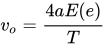
E is close to when e is small.

An approximation using a taylor series expansion is
![{\displaystyle v_{o}={\frac {2\pi a}{T}}\left[1-{\frac {e^{2}}{4}}-{\frac {3e^{4}}{64}}-\dots \right]}](https://wikimedia.org/api/rest_v1/media/math/render/svg/fa3d11206ff43ba037c4020a8ac97206a6fcb98a)
AstOrb Browser computes a velocity using Ramanujan's approximation for an ellipse's circumference:
![{\displaystyle v_{o}\approx {\frac {\pi }{T}}\left[3(a+b)-{\sqrt {(3a+b)(a+3b)}}\right]}](https://wikimedia.org/api/rest_v1/media/math/render/svg/5b886d2a7d89e724a0df29fc3226bcf611388d30)
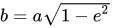
Where b is the orbit's semi-minor axis:
Surface gravity
[स्रोत सम्पादन]For a spherical body of mass m, and radius r, the gravitational acceleration at the surface, is given by
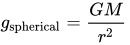
Where G = 6.6742×10⁻¹¹ m3s−2kg−1 is the Gravitational constant, M is the mass of the body, and r its radius. This value is very approximate, as most minor planets are far from spherical.
For irregularly shaped bodies, the surface gravity will differ appreciably with location. However, at the outermost point/s, where the distance to the centre of mass is the greatest, the surface gravity is still given by a simple formula, a slightly modified version of the above that uses the largest radius

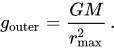
because all the body's mass is contained within this radius.
On a rotating body, the apparent weight experienced by an object on the surface is reduced by the centrifugal force, when one is away from the poles. The centrifugal acceleration experienced at the equator is
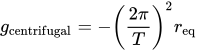
where T is the rotation period in seconds, and is the equatorial radius (usually also the maximum radius used above). The negative sign indicates that it acts in the opposite direction to the gravitational acceleration g.

The effective surface gravity at the equator is then

Escape velocity
[स्रोत सम्पादन]For surface gravity g and radius r, the escape velocity is:

This value is much less sensitive to the factors affecting the surface gravity, mentioned above.
Temperature
[स्रोत सम्पादन]For asteroid albedo α, semimajor axis a, solar luminosity , and asteroid infrared emissivity ε (usually taken to be ~0.9), the approximate mean temperature T is given by:

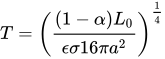
Where σ is Stefan-Boltzmann constant. See also Torrence V. Johnson; Paul R. Weissman; Lucy-Ann A. McFadden (2007). Encyclopedia of the Solar System. Elsevier. p. 294. ISBN 978-0-12-088589-3..
TemplateData
[स्रोत सम्पादन]TemplateData for Infobox planet
| मापदण्ड | विवरण | प्रकार | स्थिति | |
|---|---|---|---|---|
| Minorplanet | minorplanet | when given a value (e.g. yes) it changes labels, section headings and links to a specifically customized version for minor planets. This is a functional parameter only and has no label or value that is displayed | String | वैकल्पिक |
| Extrasolarplanet | extrasolarplanet | when given a value (e.g. yes) it changes labels, section headings and links to a specifically customized version for extrasolar planets. This is a functional parameter only and has no label or value that is displayed | String | वैकल्पिक |
| Name | name | name of planet | String | वैकल्पिक |
| Symbol | symbol | symbol of planet | String | वैकल्पिक |
| Background | background | background color for section headings | String | वैकल्पिक |
| Background | bgcolour | deprecated parameter to set background color for section headings. Use parameter 'background' instead | String | बहिष्कृत |
| Width | width | defunct parameter to set width of infobox. Do not use it. Remove it from existing templates. Width of infobox can no longer be adjusted. However, if the template contains an image, the width of the infobox will adjust accordingly and change from its default width of about 260px | String | बहिष्कृत |
| Label_width | label_width | Max width of the parameter name column
| String | वैकल्पिक |
| Image | image | image of planet | String | वैकल्पिक |
| Caption | caption | caption | String | वैकल्पिक |
| Apsis | apsis | String | वैकल्पिक | |
| Discovery | discovery | deprecated parameter to enable the 'Discovery' heading, which now displays automatically when a discovery parameter is set | String | बहिष्कृत |
| Discovery_ref | discovery_ref | <ref>...</ref>, reference displayed in section heading | String | वैकल्पिक |
| Discoverer | discoverer | discoverer of planet | String | वैकल्पिक |
| Discovery_site | discovery_site | String | वैकल्पिक | |
| Discovered | discovered | discovered | String | वैकल्पिक |
| Discovery_method | discovery_method | String | वैकल्पिक | |
| mpc_name | mpc_name | String | वैकल्पिक | |
| Pronounced | pronounced | String | वैकल्पिक | |
| Named_after | named_after | String | वैकल्पिक | |
| mp_category | mp_category | String | वैकल्पिक | |
| Alt_names | alt_names | String | वैकल्पिक | |
| Orbital_characteristics | orbital_characteristics | deprecated parameter to enable the 'Orbital characteristics' heading, which now displays automatically when an orbital characteristic parameter is set | String | बहिष्कृत |
| Orbit_ref | orbit_ref | <ref>...</ref>, reference displayed in section heading | String | वैकल्पिक |
| Orbit_diagram | orbit_diagram | image link, just like in prose. ex.: [[File:1992 TC orbital diagram.jpg|260px]] | String | वैकल्पिक |
| Epoch | epoch | String | वैकल्पिक | |
| Uncertainty_parameter | uncertainty | String | वैकल्पिक | |
| Observation_arc | observation_arc | String | वैकल्पिक | |
| Aphelion | aphelion | String | वैकल्पिक | |
| Perihelion | perihelion | String | वैकल्पिक | |
| Periastron | periastron | String | वैकल्पिक | |
| Apoastron | apoastron | String | वैकल्पिक | |
| Periapsis | periapsis | String | वैकल्पिक | |
| Apoapsis | apoapsis | String | वैकल्पिक | |
| Semimajor | semimajor | String | वैकल्पिक | |
| Mean_orbit_radius | mean_orbit_radius | String | वैकल्पिक | |
| Eccentricity | eccentricity | String | वैकल्पिक | |
| Period | period | String | वैकल्पिक | |
| Synodic_period | synodic_period | String | वैकल्पिक | |
| Avg_speed | avg_speed | (Average orbital speed) | String | वैकल्पिक |
| Mean_anomaly | mean_anomaly | String | वैकल्पिक | |
| Mean_motion | mean_motion | String | वैकल्पिक | |
| Inclination | inclination | String | वैकल्पिक | |
| Angular_dist | angular_dist | (Angular distance) | String | वैकल्पिक |
| Asc_node | asc_node | (Longitude of ascending node) | String | वैकल्पिक |
| Long_periastron | long_periastron | (Longitude of periastron) | String | वैकल्पिक |
| Time_periastron | time_periastron | (Time of periastron) | String | वैकल्पिक |
| Arg_peri | arg_peri | String | वैकल्पिक | |
| Semi-amplitude | semi-amplitude | String | वैकल्पिक | |
| p_orbit_ref | p_orbit_ref | <ref>...</ref>, reference displayed in section heading | String | वैकल्पिक |
| p_semimajor | p_semimajor | String | वैकल्पिक | |
| p_eccentricity | p_eccentricity | String | वैकल्पिक | |
| p_inclination | p_inclination | String | वैकल्पिक | |
| p_mean_motion | p_mean_motion | (Proper orbital mean motion) | String | वैकल्पिक |
| Perihelion_rate | perihelion_rate | (Proper perihelic precession rate) | String | वैकल्पिक |
| Node_rate | node_rate | (Proper nodal precession rate) | String | वैकल्पिक |
| Satellite_of | satellite_of | String | वैकल्पिक | |
| Satellites | satellites | String | वैकल्पिक | |
| Moid | moid | String | वैकल्पिक | |
| Mercury_moid | mercury_moid | String | वैकल्पिक | |
| Venus_moid | venus_moid | String | वैकल्पिक | |
| Mars_moid | mars_moid | String | वैकल्पिक | |
| Jupiter_moid | jupiter_moid | String | वैकल्पिक | |
| Saturn_moid | saturn_moid | String | वैकल्पिक | |
| Uranus_moid | uranus_moid | String | वैकल्पिक | |
| Neptune_moid | neptune_moid | String | वैकल्पिक | |
| Tisserand | tisserand | String | वैकल्पिक | |
| Physical_characteristics | physical_characteristics | deprecated parameter to enable the 'Physical characteristics' heading, which now displays automatically when a physical characteristic parameter is set | String | बहिष्कृत |
| Dimensions | dimensions | String | वैकल्पिक | |
| Flattening | flattening | String | वैकल्पिक | |
| Equatorial_radius | equatorial_radius | String | वैकल्पिक | |
| Polar_radius | polar_radius | String | वैकल्पिक | |
| Mean_radius | mean_radius | String | वैकल्पिक | |
| Circumference | circumference | String | वैकल्पिक | |
| Surface_area | surface_area | String | वैकल्पिक | |
| Volume | volume | String | वैकल्पिक | |
| Mass | mass | String | वैकल्पिक | |
| Density | density | String | वैकल्पिक | |
| Surface_grav | surface_grav | (Equatorial surface gravity) | String | वैकल्पिक |
| Moment_of_inertia_factor | moment_of_inertia_factor | (Moment of inertia factor) | String | वैकल्पिक |
| Escape_velocity | escape_velocity | String | वैकल्पिक | |
| Sidereal_day | sidereal_day | String | वैकल्पिक | |
| Rot_velocity | rot_velocity | (Rotational velocity) | String | वैकल्पिक |
| Axial_tilt | axial_tilt | String | वैकल्पिक | |
| Right_asc_north_pole | right_asc_north_pole | (North pole right ascension) | String | वैकल्पिक |
| Declination | declination | (North pole declination) | String | वैकल्पिक |
| Pole_ecliptic_lat | pole_ecliptic_lat | (Pole ecliptic latitude) | String | वैकल्पिक |
| Pole_ecliptic_lon | pole_ecliptic_lon | (Pole ecliptic longitude) | String | वैकल्पिक |
| Albedo | albedo | String | वैकल्पिक | |
| Single_temperature | single_temperature | String | वैकल्पिक | |
| Temp_name1 | temp_name1 | String | वैकल्पिक | |
| Min_temp_1 | min_temp_1 | String | वैकल्पिक | |
| Mean_temp_1 | mean_temp_1 | String | वैकल्पिक | |
| Max_temp_1 | max_temp_1 | String | वैकल्पिक | |
| Temp_name2 | temp_name2 | String | वैकल्पिक | |
| Min_temp_2 | min_temp_2 | String | वैकल्पिक | |
| Mean_temp_2 | mean_temp_2 | String | वैकल्पिक | |
| Max_temp_2 | max_temp_2 | String | वैकल्पिक | |
| Spectral_type | spectral_type | String | वैकल्पिक | |
| Magnitude | magnitude | (Apparent magnitude) | String | वैकल्पिक |
| Abs_magnitude | abs_magnitude | (Absolute magnitude) | String | वैकल्पिक |
| Angular_size | angular_size | String | वैकल्पिक | |
| Pronounced | pronounced | {{IPA-en|<!-- IPA string -->|}} | String | वैकल्पिक |
| Adjectives | adjectives | String | वैकल्पिक | |
| Atmosphere_ref | atmosphere_ref | <ref>...</ref>, reference displayed in section heading | String | वैकल्पिक |
| Surface_pressure | surface_pressure | String | वैकल्पिक | |
| Scale_height | scale_height | String | वैकल्पिक | |
| Atmosphere_composition | atmosphere_composition | String | वैकल्पिक | |
Microformat
[स्रोत सम्पादन]The HTML mark up produced by this template includes an hCard microformat, which makes the place-name and location parsable by computers, either acting automatically to catalogue article across Wikipedia, or via a browser tool operated by a person, to (for example) add the subject to an address book. For more information about the use of microformats on Wikipedia, please see the microformat project.
If the place or venue has an "established", "founded", "opened" or similar date that is specific to the day, use {{start date}} unless the date is before 1583 CE. If it has a URL, use {{URL}}.
hCard uses HTML classes including:
- adr
- category
- country-name
- extended-address
- fn
- label
- locality
- nickname
- note
- org
- street-address
- url
- vcard
Please do not rename or remove these classes nor collapse nested elements which use them.
References
[स्रोत सम्पादन]